
Geography sticks when students are having fun, not memorising a list of capitals for a test. A good classroom game turns a map into something the whole room leans into. The trouble is that most "geography games" lists are written for solo players at home, not for a teacher facing 28 students, locked-down Chromebooks, and a 40-minute period.
So we tested the options the way a classroom actually uses them: in a normal browser, no accounts, no purchases, counting every ad and pop-up along the way. Everything was last re-tested on July 5, 2026, and every screenshot below is our own. One disclosure up front: we build CityGuesser, one of the games in this guide, and it was tested by the same rules as the rest.
Short on time? For whole-class multiplayer, Maponica CityGuesser (up to 250 students, no accounts, works where Street View is blocked). For drilling countries and capitals, Seterra. For a quick warm-up or exit ticket, Worldle or Globle. All free, all browser-based.
What makes a geography game classroom-ready
A game can be brilliant at home and useless in class. Before a game earns a spot in a lesson, it has to clear a few practical bars:
- No accounts or logins. Every password reset costs you a minute, and 28 of them cost you the lesson. The best classroom games start with a shared link or code.
- Works on the school network. Filters block game sites as a category, and many also restrict Google's Street View service, which quietly breaks every Street-View game. Video and quiz games usually sail through.
- Runs on a Chromebook. No install, no plugin, no app store. If it needs more than a browser tab, it will not survive IT.
- Safe on a projector. Ads and pop-ups you'd shrug off at home look very different on a wall in front of a class.
- Works for a group. Either real multiplayer, or a single screen the whole class can play from the front.
Whole-class multiplayer
This is where a geography game earns its place: everyone plays the same round at once, and the room reacts together.
Maponica CityGuesser
The strongest fit for a live, whole-class lesson. Walking-tour videos, up to 250 players, no accounts, no ads, and it loads where Street View is blocked.
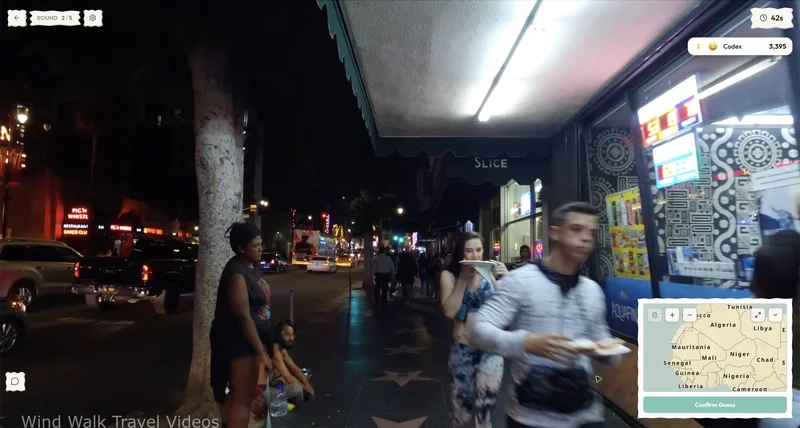
This one is ours. A round in progress: the class watches the same walking-tour video and everyone places their own guess.
CityGuesser plays a real walking-tour video, and students guess the location on a map. You hear the street, catch shop signs and language clues, and argue about them afterwards. Because it runs on video instead of Street View, it doesn't depend on the Google service that school filters usually restrict, which is the single most common reason geography games fail in a lab (as long as your school allows YouTube).
Setup is built for a lesson, not a login screen. You open a room, share the code (or put it on the board), and students join from any device with no account. In our test, landing page to playing took 2 clicks plus a nickname, with no cookie pop-ups and no ads anywhere, which matters when the screen is on a projector. Rooms hold up to 250 players, you can filter the video pool by region or theme to match what you're teaching, and the reveal map with everyone's pins is reliably the loudest moment of the period. For lesson ideas and classroom settings, see our page for teachers.
Drill the map
When the goal is recall (countries, capitals, rivers) a fast click-the-map quiz beats a worksheet and gives instant feedback.
Seterra
The long-standing classroom favourite for structured practice. 400+ quizzes and printables, with two 2026 caveats: heavy ads, and it now lives on GeoGuessr's site.
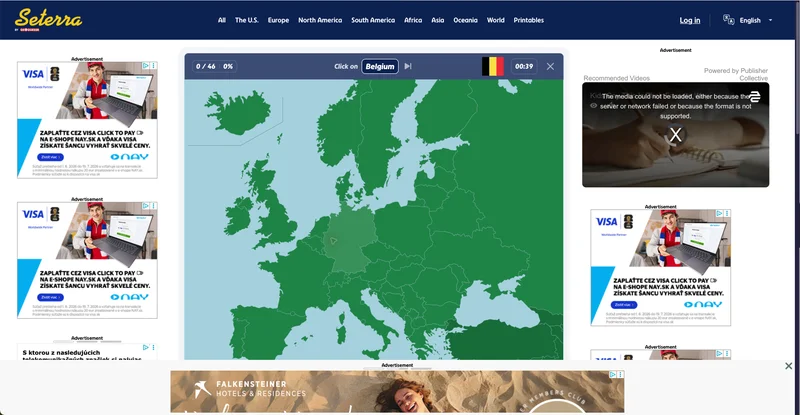
Europe: Countries in progress, with the 2026 ad experience around it. We counted 6 to 7 ads on screen during a quiz, worth knowing before you project it.
Seterra has over 400 map quizzes covering countries, capitals, flags, rivers, and mountains, in 40+ languages, with printable worksheets for offline work. Students click locations on a map and get corrected on the spot, which is why teachers have leaned on it for years. We ran World: Continents in 1:05 at 100%; the drills hold up.
Two things changed since its classic era. GeoGuessr bought Seterra in 2022, and the quizzes now run on GeoGuessr's site, so if your school blocks GeoGuessr, Seterra goes down with it. And the free version carries a lot of advertising around the quiz area, so for projector use, consider loading the quiz before the class files in.
Quick warm-ups and exit tickets
Sometimes you want five minutes, not a whole activity. These fit at the start or end of a period, and because everyone gets the same daily puzzle, the class can solve it together from the front.
Worldle
Wordle for geography. One country silhouette, six guesses, perfect as a daily warm-up.
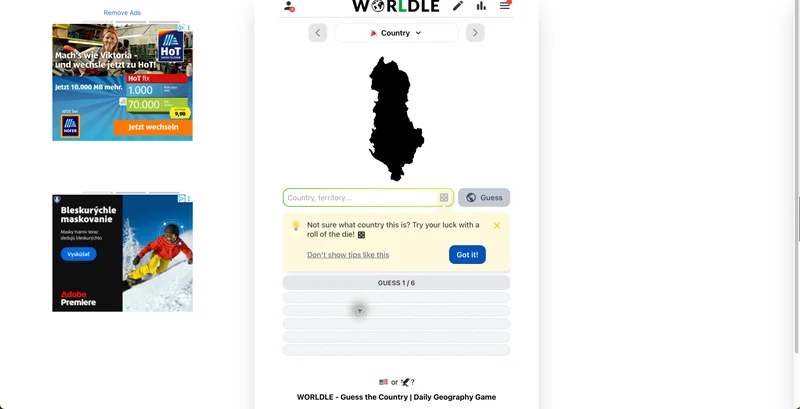
Puzzle #1626 from our test day. That silhouette was Albania; distance and direction hints guide every next guess.
Worldle shows a country silhouette and gives six guesses to name it, with distance and direction hints after each try. It takes two minutes, which makes it an ideal bell-ringer or exit ticket. Put it on the board, take guesses from the room, and debate the clues as you narrow it down.
No registration, no account, no setup. One practical note: the official game is at worldle.teuteuf.fr. Similarly named sites like worldle.cc are unofficial ad-heavy copies, not what you want on a projector.
Globle
Name the mystery country; the globe glows warmer as guesses get closer. The best whole-class deduction game.
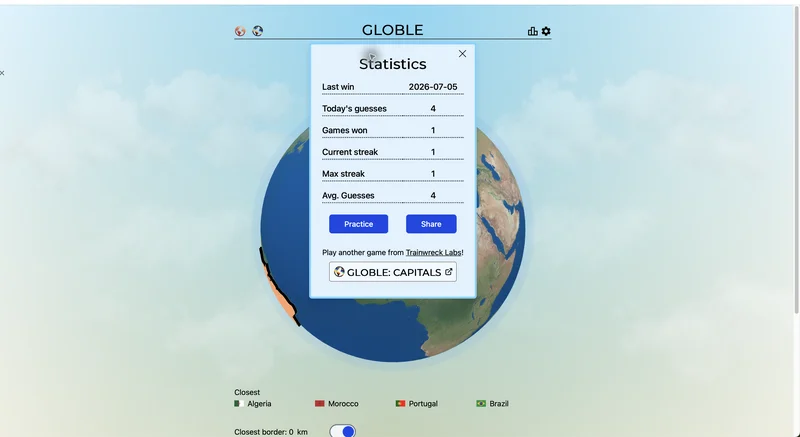
Our test day's puzzle, solved in four: Brazil, Portugal, Morocco, then the heat trail led to Algeria.
Globle gives you a spinning globe and a text box. Students name a country, it lights up on a heat scale, and warmer means closer. It teaches borders and relative position better than any quiz, because every wrong guess is information. Run it from the front and let the room argue about the next guess; the geography happens in the arguing. Free, no account, and there's a Capitals version from the same maker when country shapes get too easy.
Travle
Connect two countries with the shortest chain of neighbors. A brilliant five-minute border drill.
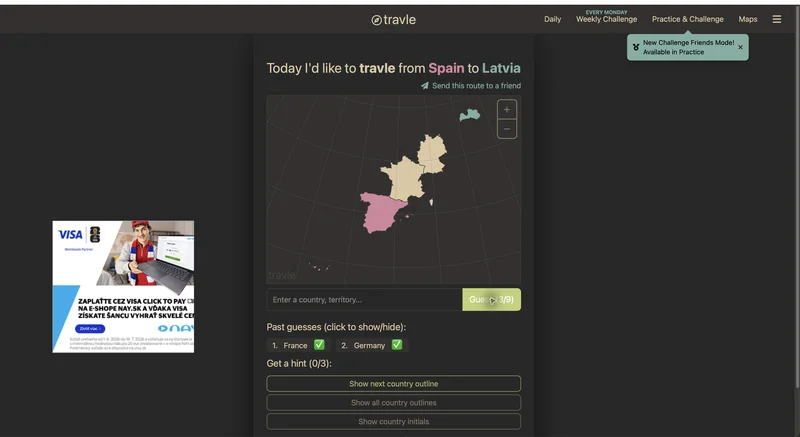
From our test day: Spain to Latvia, solved with the optimal France, Germany, Poland, Lithuania chain.
"Today I'd like to travle from Spain to Latvia." Students name the countries that connect them, in as few steps as possible. It sounds trivial until the route crosses Central Asia and nobody is quite sure what borders what. As a projected class puzzle it's excellent: every suggestion is a small border-knowledge check, and the optimal-route reveal at the end settles the debate.
What about GeoGuessr itself?
GeoGuessr is the game most students will name, so it's worth being clear about how it behaves in school in 2026.
The free tier is now a single Daily Challenge (5 locations), and even that requires creating an account; the button literally says "SIGN-UP AND PLAY". Unlimited play starts at €2.99 a month billed yearly. On top of that, school filters commonly block it (there are student petitions about exactly this), and Street View games in general tend to fail on school networks. If your network allows it and your budget covers it, it's a polished product. For a free, no-account, whole-class lesson, the picks above get you further. We compared the full field, school-friendliness included, in our GeoGuessr alternatives guide.
How to run a geography game in five minutes
You don't need a lesson plan to start. A simple loop works:
- Pick the goal. Recall practice (Seterra), a live shared experience (CityGuesser), or a quick starter (Worldle, Globle).
- Open it on the projector and put the join code or link on the board.
- Get students in. For CityGuesser, they enter the code, no account. For quiz tools, the class plays from the front.
- Play one round together, then pause on the answer and ask why. The "why" is the geography.
- Keep score lightly. A little competition raises energy. Make the takeaway the place, not the points.
Run the same game weekly and it becomes a routine students look forward to.
Which one for your classroom
If you want the whole class playing together and reacting in real time, start with CityGuesser: it's free, needs no accounts, and loads where Street View is blocked. If your goal is straight recall of countries and capitals, Seterra gives you endless structured practice (just mind the ads and the GeoGuessr-domain caveat). And for a sharp opener or exit ticket, Worldle, Globle and Travle each fill five minutes with more geography than a worksheet manages in twenty.
Teaching in German? The free options for German-speaking classes are covered in our GeoGuessr-Alternativen guide. And when you're ready to play together, our teacher page has the settings and ideas to make it a regular part of the week.